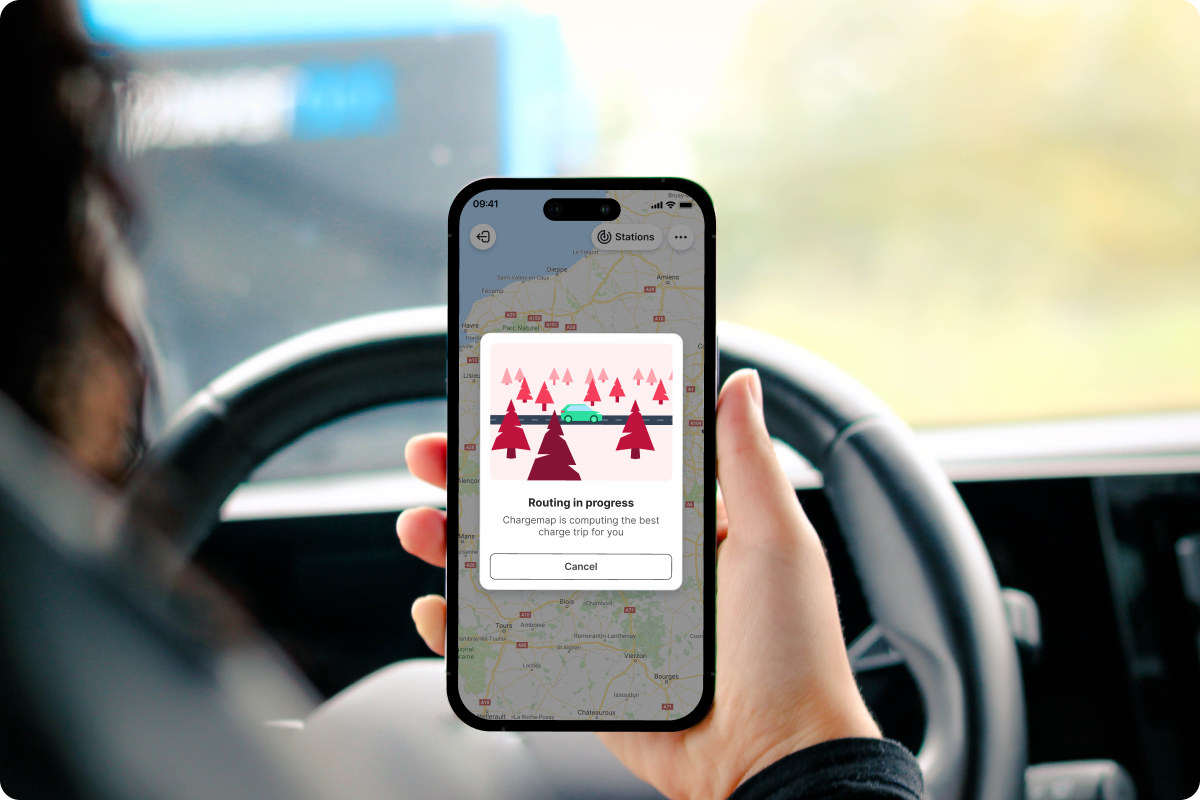
A bad route is never just a detour for a fleet: it means a vehicle off the road for longer, a driver caught off guard, a charging stop in the wrong place. Chargemap is upgrading its route planner to make planning your business journeys across Europe even more reliable.
Points to remember
- A route planner that calculates journeys twice as fast, up to 4 times faster on some routes
- Better optimised routes: 70% fewer U-turns, 18% fewer unnecessary motorway exits
- The biggest benefit for shorter-range vehicles, often the most constrained in urban fleets
- A calculation engine built and maintained in-house by Chargemap's technical teams
A route planner designed and built by our own teams
The Chargemap route planner runs on a calculation engine built in-house, with proprietary algorithms designed and refined by our technical teams. This full control over the engine lets us fine-tune every parameter, charging point reliability, real-world vehicle behaviour, network constraints, for ever more reliable business journeys.
1. A route planner twice as fast
The new calculation engine works twice as fast as before, up to 4 times faster on some routes. For a fleet, this gain adds up quickly: when you need to plan or adjust several routes in a single day, whether for a last-minute change of round or a new vehicle joining the fleet, this reduced calculation time translates directly into better operational responsiveness.
2. Better optimised routes
Once the route is calculated, it is more direct too: in our internal tests, the number of U-turns drops by 70% and unnecessary motorway exits by 18%, for a route that is, on average, 22 km more direct.
Shorter-range vehicles benefit the most, a key point for urban fleets or service vehicles, which are often the most constrained. In practice, for a 27.5 kWh city car, a route that previously required 10 charging stops now needs only 8 with the new route planner, cutting journey time by almost 40 minutes. A genuine gain for vehicle availability and the way you organise your rounds.
3. Less time lost charging, more vehicles on the road
Fewer stops, better placed: in our tests, the number of charging stops drops by around 10%, departures with an overly low battery become 6 times rarer, and stops take place at charging points with noticeably more reliable availability. A direct benefit for your vehicles' downtime, and for keeping your fleet's charging budget under control.
How did we test these improvements?
Our teams compared both versions of the route planner on the same dataset: over 1,000 requests, 184 real-world journeys, 5 European countries, 5 vehicle profiles, and more than 241,000 charging stations, using the same rates and terrain for both versions tested.
These results come from our internal testing phase. They give a representative trend of the improvements made, but results observed in production may vary depending on actual traffic and charging conditions.
Want to see in detail how the route planner works and how to get the most out of it day to day? Read our full guide.
This route planner update will be deployed directly within the Chargemap app. If your team already has the app, make sure it's up to date to benefit from these improvements as soon as they roll out. If some of your drivers don't have it yet, now's the time to install it.