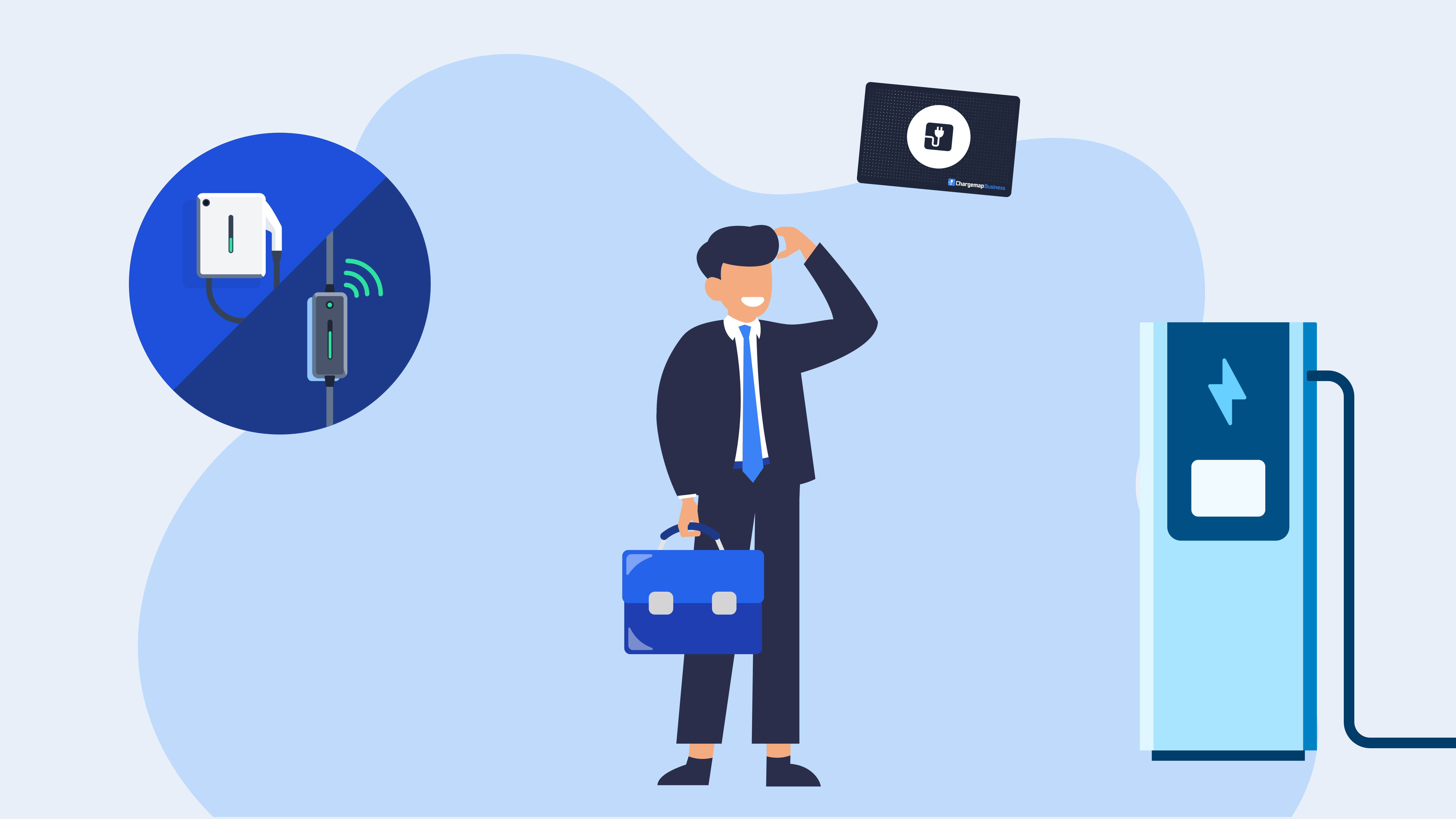
You are electrifying your fleet, or planning to. There are many charging solutions: charging stations to install, charging cards, connected cables, network subscriptions, management platforms. How do you choose the one that suits your company?
For a small business with 1 to 10 vehicles, the constraints are specific: no dedicated fleet manager, tight budgets and rarely an IT team to roll out a complex tool. The goal is therefore to choose a solution that is simple, reliable and reduces paperwork rather than adding to it.
In this article, we review the main options and help you set up a solution that suits your company.
Key takeaways:
- There is no one-size-fits-all solution: each situation (frequent travel, vehicles parked on site, employees charging at home) calls for a tailored answer.
- For charging on the road, a professional charging card is the essential foundation.
- For home charging, the connected cable is the fastest option to roll out, with no building work.
- For on-site charging, one or two connected charging stations are usually enough.
- The main challenge is centralisation: a single invoice, a single dashboard and no receipts to reimburse.
- The Chargemap Business Classic and Advanced packages are available online, without an appointment.
- Choosing a charging solution for a small fleet is not about selecting a single product. It is about answering a broader question: where do the vehicles charge, and under what conditions?
Solution 1: the professional charging card, the priority for mobile fleets
If your drivers travel, even occasionally, a professional charging card is usually the first solution to roll out. Without a dedicated tool, this is often where operational difficulties appear first.
What it is. A charging card, also called an RFID pass or charging badge, gives a driver access to public charging stations on many networks, without creating an account or paying upfront. Billing is centralised at company level, with a single monthly invoice and the details of each session.
What it changes in practice. Without a professional card, the driver has to find an available charging station, download the network's app, pay with a personal card, keep a receipt and submit it at the end of the month. Across several drivers and repeated trips, this creates a significant administrative workload and makes costs harder to control. With one card per vehicle, charging is done simply with a card, and data is consolidated automatically: network used, duration, energy consumed and cost.
The deciding criterion: network coverage. Not all cards are equal on this point. Limited coverage means juggling several apps and payment methods. The Business Chargemap Pass gives access to more than 2,000 compatible networks in France and Europe, including fast charging networks on motorways for long journeys.
Solution 2: the on-site charging station, useful but not always a priority
Installing one or two charging stations in the company car park is often the first option considered. It makes sense: when vehicles are parked on site overnight or between jobs, they can charge independently.
When this solution makes sense. An on-site charging station is suitable if vehicles regularly return to the same place (head office, depot, branch) and if the electrical infrastructure allows it. For a small fleet, one or two AC charging stations of 7 to 22 kW are usually enough. Fast charging is generally not needed for everyday professional use.
Watch out: connectivity. A non-connected charging station offers little visibility: it becomes hard to identify usage, measure the energy consumed or detect a fault. Even with two charging points, it is better to choose controllable equipment with access to a dashboard. This gives you reliable, usable data on real costs.
What this solution does not cover. An on-site charging station covers charging at the office, but not the needs of drivers on the road, nor those of employees who take their vehicle home. If your teams travel, you will need to combine an on-site charging station with a charging card.
To find out more: Company charging stations: obligations, grants and costs for 2026
Solution 3: home charging, a flexible alternative
When company vehicles are charged at employees' homes, there are two main options: the connected cable, plugged into a domestic or reinforced socket, and the wallbox, a fixed charging station installed at home.
Home charging for employees: fixed charging station or connected cable?
Download the guide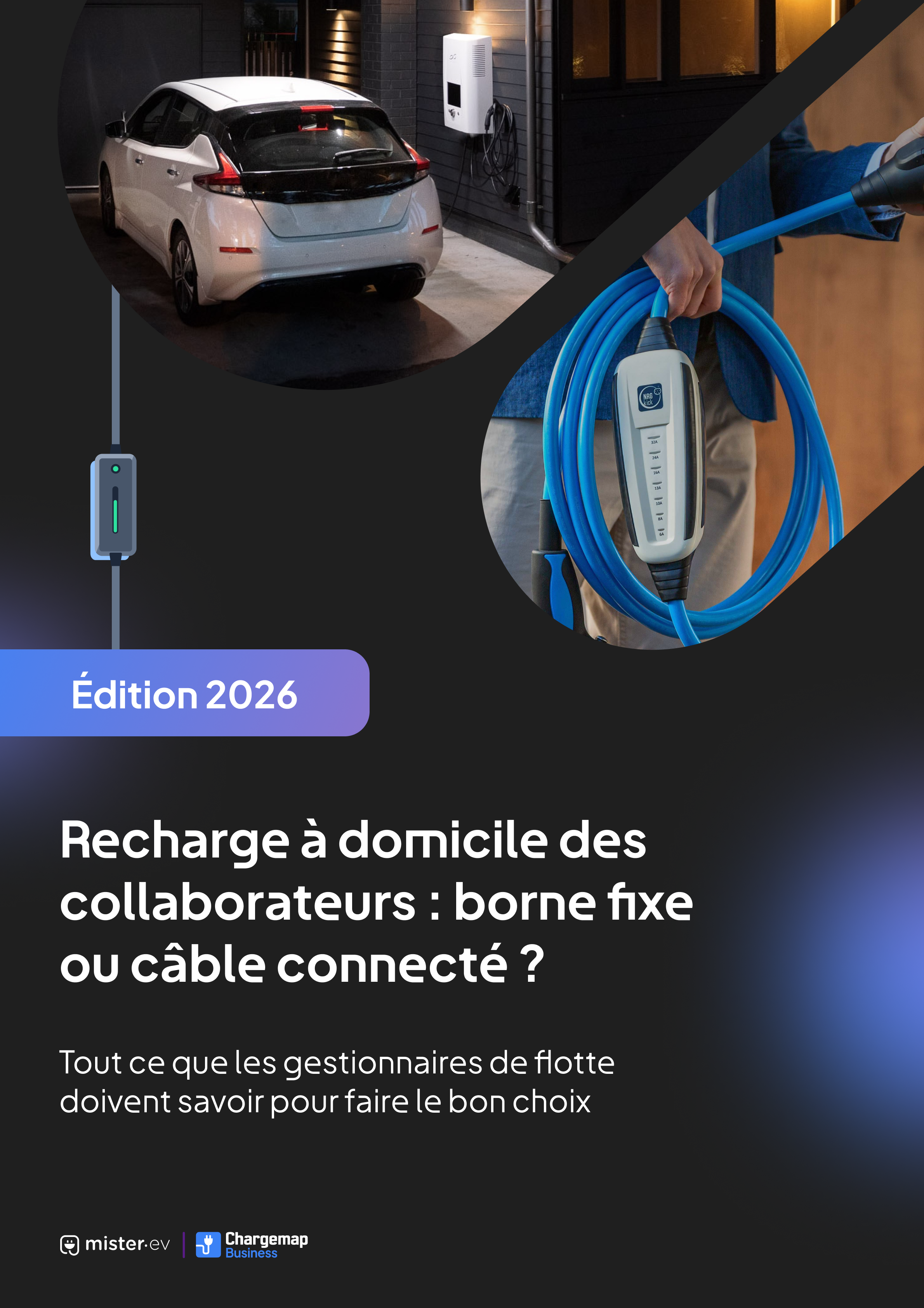
The connected cable is the fastest option to roll out, with no major building work: the unit plugs into an existing socket. However, the power level depends heavily on the type of socket.
On a standard domestic socket (2.3 kW), it takes around 18.5 hours to recover 40 kWh. This solution, which requires no investment, is mainly suited to occasional use or low mileage.
On a reinforced Green'Up socket (3.7 kW), charging time drops to around 12 hours, which generally meets the needs of overnight charging. Installation requires an electrician (a few hundred euros) and is a good compromise for equipping quickly.
The wallbox (7.4 kW) offers the best convenience: around 6 hours to recover 40 kWh, with monitoring and automated reimbursement depending on the solution chosen. Allow around €800 for the equipment and installation. This option is suited to intensive use or when the vehicle cannot stay plugged in all night.
- Connected cable, domestic socket: 2.3 kW, around 18.5 h
- Connected cable, Green'Up socket: 3.7 kW, around 12 h
- Wallbox: 7.4 kW, around 6 h
Estimates for 40 kWh recovered, indicative values depending on the vehicle.
In both cases, automatic expense solutions are available: home consumption is measured and reimbursed to the driver, with no upfront payment.
How to choose based on your situation
Rather than looking for the ideal solution, start from your actual situation.
Do your drivers travel regularly? Start with the charging card. It is the most immediate building block, the fastest to roll out, and the one that solves the main day-to-day operational pain point.
Are your vehicles parked on site overnight? Add one or two connected charging stations. Two properly monitored charging points bring more value than a fleet of unmanaged charging stations.
Do your employees use the vehicles at home? Look at home charging solutions, with a connected cable for fast roll-out and a fixed charging station for intensive use. Automatic reimbursement avoids any extra administrative workload.
Do you want to centralise everything without spending time on it? That is exactly the purpose of the Chargemap Business Classic and Advanced packages: access to the public charging network, monitoring of on-site charging stations and a unified dashboard, all available directly online, without a sales appointment.
For a small fleet, the challenge is not just being able to charge. It is about controlling spending, reducing expense claims and having reliable indicators to manage your TCO.
With Chargemap Business, you benefit from a unified approach:
- Centralisation of charging on the road (card) and consumption data.
- Automatic reimbursement of home charging, with no upfront costs or receipts.
- Cost tracking and management via a single dashboard, to analyse usage, compare sites and detect overspending.
- TCO optimisation thanks to a clear view of energy costs and equipment choices aligned with your actual usage.
By starting from your situation (travel, site, home), you roll out the most relevant combination and save time, while staying in control of your budget.